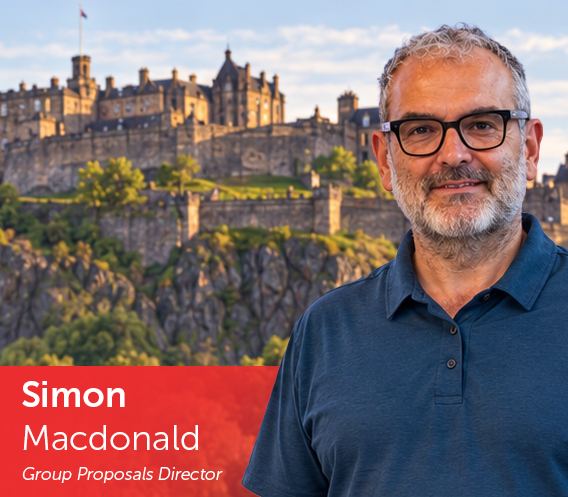
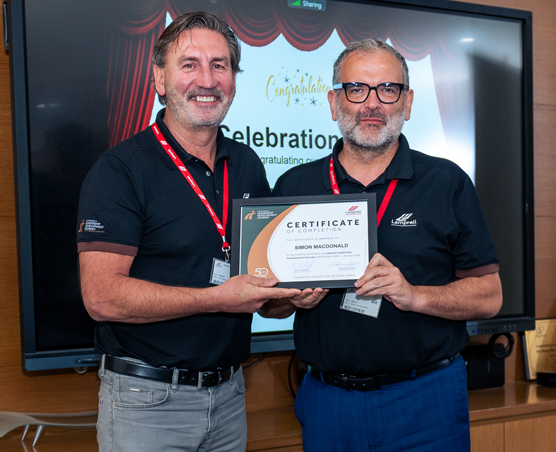
As Lamprell celebrates its 50th anniversary, we are speaking with colleagues who have helped shape its story. Simon MacDonald, Group Proposals Director, has spent more than 25 years with the company. We asked him about the people and projects that have stayed with him, how the business has changed and the life he has built along the way.
As Lamprell marks 50 years and you reflect on more than 25 of your own here, what comes to mind first?
Probably how much the business has grown and evolved while still retaining the family feel that was there when I joined. Lamprell is much bigger today, with broader capabilities, more complex projects and teams working across a wider footprint, but the sense of people knowing each other, supporting one another and working together towards the same outcome has stayed remarkably consistent.
The way we work with clients also comes to mind. I joined from a company where the approach was very claims-driven. Lamprell was different. We wanted the project in front of us to succeed, but we were also thinking about the second and third projects. You wanted the client to leave happy and to want to work with you again.
Take us back to the beginning. What brought you to Lamprell, and what was your life like before you joined?
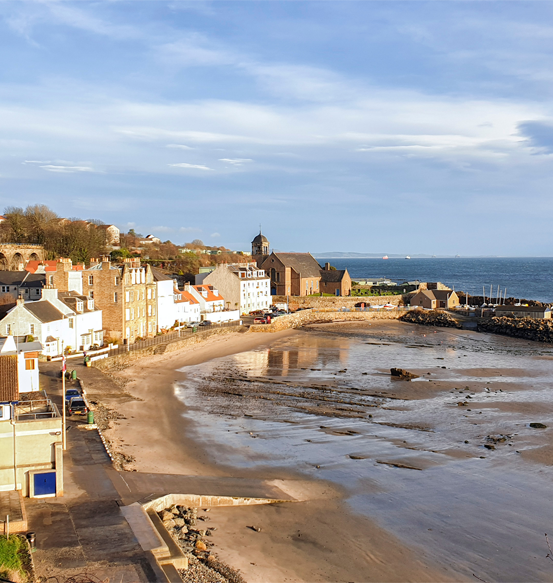
I grew up in Kirkcaldy in Fife, on the east coast of Scotland. My Mum was a single parent, so my Gran and Grandad played a big part in bringing me up. I still remember my Grandad telling me: “Always work hard in your job because that is what pays your bills.” That stayed with me and has played a big part in shaping how I approach work and my career.
My first job was at Consafe, an offshore fabrication yard, as a Technical Clerk and Document Controller. I was logging, printing and distributing the drawings and specifications the project teams and yard needed to design, procure and build offshore structures. After a couple of years, someone decided I might be useful to the Estimating department, which was a very small and very busy team, and I gradually moved into preparing estimates and proposals for North Sea oil & gas projects.
Life outside work was fairly typical – music, friends, clothes and football. I was playing semi-professional football in Fife and had turned down a job in New Zealand. When the Lamprell opportunity came up, though, there was no doubt in my mind.
I officially joined on 1 October 2000. The work was serious and people were committed to getting projects delivered, but the social side was also fantastic. Lamprell knew how to look after its employees.
How has your career developed at Lamprell?
I hear people talk about the mentor who shaped their career, but I don’t think I have ever had only one particular person I would describe that way.
What I have had is the chance to learn from lots of different people. In recent years, that has included senior leaders with backgrounds at KBR, Petrofac and McDermott. Their experience of delivering major EPCI projects globally has brought different perspectives to Lamprell and broadened my own understanding of the industry. You absorb a lot from that.
The current management team at Lamprell has also shown that you can be completely down to earth, speak plainly and still be very effective at leading people and driving a successful business.
Then there is my own team. Almost a quarter of the current Proposals and Estimating team have been with Lamprell for close to 15 years. Most of that is down to the culture Lamprell has created, and if a small part is because they have enjoyed being part of our team, then that is quite humbling.
You have worked through several generations of Lamprell leadership. How has the company changed, and what has always felt distinctly Lamprell to you?
If you look at the physical growth alone, we went from Port Khalid to Jebel Ali and then Hamriyah. The work moved from rig refurbishment into process topsides, new build jack-ups and eventually full Offshore EPCI capability.
Lamprell has changed enormously, but what has remained familiar is the family-business feel and the emphasis on working with clients as partners rather than simply delivering a job and moving on.
More recently, the current management team has brought a very straightforward focus to the business. They are capable, direct and firmly focused on execution, and that approach has delivered results.

When you look back at the work you have helped Lamprell win, which opportunity are you especially proud to have been part of?
Nexen GEAD and ConocoPhillips Jasmine showed that Lamprell could compete internationally and work directly with Tier 1 oil & gas operators. Renewables took us into a completely different market, and the EPCI awards under our LTA with Aramco confirmed our progression from fabricator to a genuine EPCI contractor.
I still remember the Perro Negro 2 refurbishment for Saipem in the early 2000s. Saipem had not had a rig in our yard for several years, so getting them back was a big deal for us at that point. They subsequently remained a rig client for many years.
How has the way Lamprell wins work changed over the years?
Our markets have broadened and so has the competition. When we were predominantly a rigs business, our competitive environment was much more regional. With renewables and Offshore EPCI, we are competing globally.
Clients have also become much more sophisticated in how they procure and manage projects, so bidding has inevitably become more complex.
The basic job hasn’t really changed, though: understand what the client needs, work out whether we can deliver it successfully and put forward a competitive offer.
Your role brings bids, estimating and proposals together. For someone who has never worked on a bid, how do those teams turn an opportunity into something Lamprell can deliver?
The first question is whether we should bid at all.
We need to be satisfied that the project is real, that Lamprell has a credible way to execute it and that there is an opportunity to deliver profitably. If those fundamentals aren’t there, there is little point in putting a large part of the organisation through a major bid.
Once we decide to proceed, the bid kick-off brings the wider team together. We explain the project, what the client wants and how we intend both to develop the proposal and position Lamprell to win.
Estimating then pulls together costs from all supporting departments. We don’t simply add the numbers up. The team checks, challenges and benchmarks them against current and previous project data so we arrive at the most competitive cost we can stand behind.
Proposals coordinates the whole exercise and makes sure everything the client requires – technical, commercial and contractual – comes together into one submission.
Many people outside our function may only ever see the finished bid. Behind it can be weeks or months of input from Engineering, Supply Chain, Operations, Commercial, Contracts, Risk Management, Finance and many other teams, often working against a very fixed deadline. Our job is to bring it all together into one coherent Lamprell offer.
Two things can make that job considerably harder: late inputs and unnecessary contingency built into individual cost estimates. Every late input reduces the time available to review, benchmark and challenge the numbers properly, while adding extra quantities or cost “just to be on the safe side” can quickly make the overall bid less competitive. The stronger and more transparent the inputs we receive, the better our chance of putting forward a robust offer that can win.
You have seen Lamprell build on its oil & gas experience to take on offshore wind work. Which skills have carried across, and what has the company had to learn?
The biggest adjustment was moving from predominantly bespoke oil & gas projects to something much closer to a production-line workflow with multiple, almost identical, structures.
If you have an issue in one area of a one-off topsides project, you may be able to move to other work fronts while it is resolved. With multiple offshore wind structures moving through the same sequence, an early delay can affect the repeat activities that follow. That requires a different way of thinking about planning, production and repeatability, and it has been an important learning curve for the business.
After more than 25 years, what still gives you a sense of purpose in your work?
A lot of it comes back to the Proposals and Estimating team. It can be relentless – there is always another opportunity, another deadline and another submission to get out – but I have watched people consistently support each other and keep pushing towards the next successful award.
I also get a lot of satisfaction from seeing people stay with Lamprell, develop and take on more responsibility. If I have played even a small part in creating an environment where people want to do that, I am proud of it.
And after all these years, there is still a buzz when we win something.
What advice would you give someone starting out in your field?
Learn to stay calm under pressure. Heavy workloads and tight deadlines are part of proposals and estimating, but how you react to them affects everyone around you. Over the years I have learned that being level-headed helps the team think more clearly, work through problems and make better decisions.
Pressure is unavoidable; adding to it usually isn’t helpful.
The UAE has been part of your life for a long time. What has living here given you, personally as well as professionally?
I have spent more of my adult life in the UAE than I have in the UK. My career with Lamprell is what originally kept me here, but the UAE has become home for me and my family.
In the early years it almost felt like home-from-home. I played in the expat football league with a team made up mainly of Scots and many of the friendships I made then are still part of my life today. Family and friends from home have visited over the years too and have always loved the UAE – the brunches certainly helped.
One of the things I value most is how international life here is. That is true at work, but also among my friends. I went to a desert barbecue earlier this year and counted 23 different nationalities there. I remember thinking how extraordinary that was, and yet in the UAE it somehow also feels completely normal.
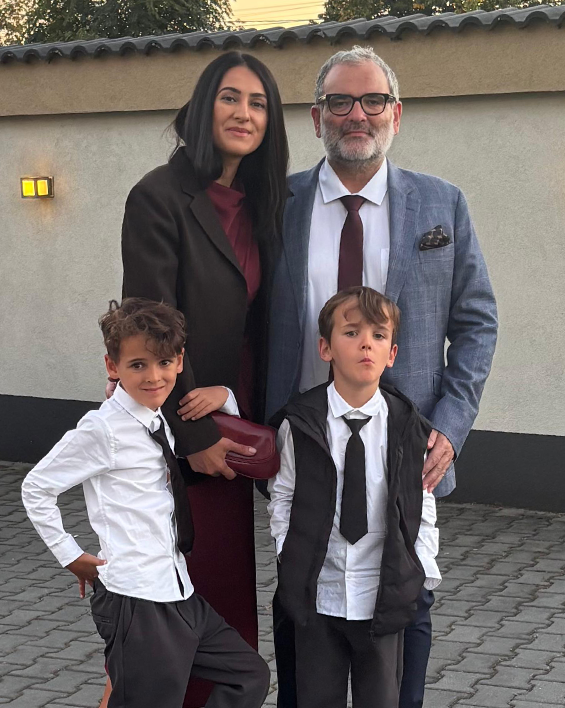
Most importantly, I met my wife Natalia here and our twin sons, Harris and Harvey, were born here. So professionally and personally, the UAE has given me far more than I could ever have imagined when I arrived 25 years ago.
Away from deadlines and bid submissions, what side of Simon do your colleagues rarely get to see?
Most of my free time now is spent with the family.
As much as I would love the boys to play football like I did, I have never pushed it. For a long time they showed very little interest, but recently that has changed and now we spend plenty of time in the park playing “Scotland in the World Cup Final”.
We always win.